4.9 / 5 from 229 verified repairs
Owner rating across our wider Bay Area Sub-Zero service network.
★★★★★
Common problems
Common San Rafael Sub-Zero problems are sorted by symptom and evidence
Common San Rafael Sub-Zero problems include warm fresh-food sections, both sections warming, frost or condensation at the door, hollow ice, slow harvest, alarms, wine-zone drift and long run times. Each symptom should be tied to model proof, temperature readings, airflow, water-path or cabinet-access evidence before a part is named.
1 Read temperatures2 Inspect airflow3 Verify part by serial
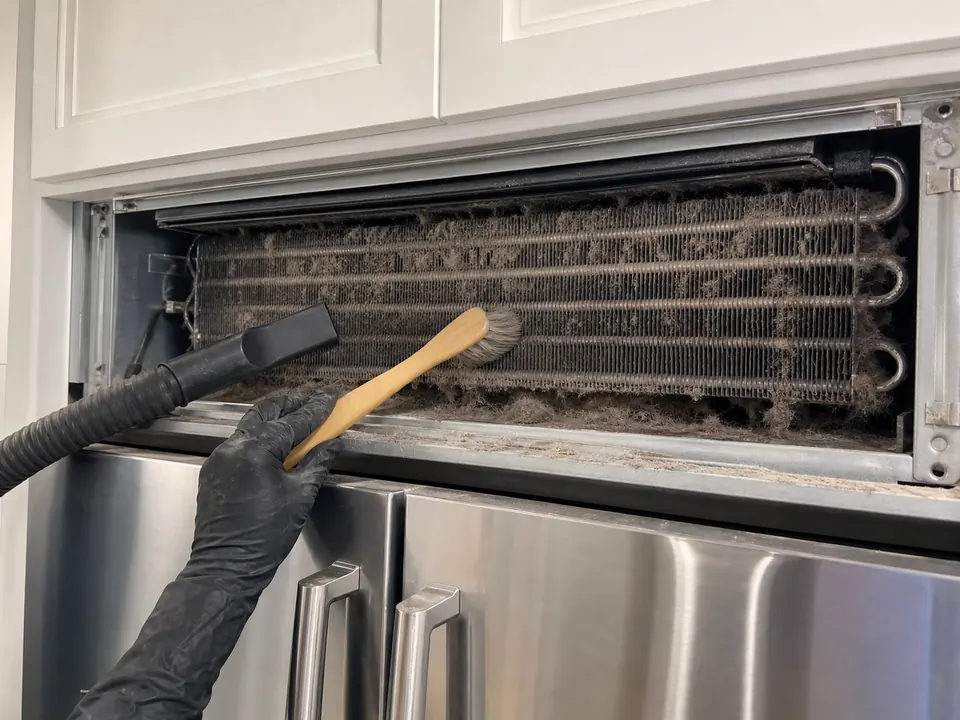
A packed condenser can make a Sub-Zero run warm without meaning the compressor has failed.
What the intake is trying to prove
A symptom list is useful only if it prevents false certainty. The same warm-cabinet complaint can come from airflow, sensors, fans, door leaks, condenser dust, controls or sealed-system trouble. The page routes each problem toward the first evidence that narrows it safely.
San Rafael conditions add practical clues: fog and humidity expose weak seals, hillside dust blocks condensers, older built-ins complicate access, and wine or food-loss urgency changes timing. None of those details overrides the diagnostic sequence.
San Rafael Sub-Zero common-problem sorting price and time table
Planning ranges are visible because they help owners make a practical decision. Final quote depends on model, part availability, cabinet access and diagnosis.
Service or symptom
What is included
Planning range
Time window
Hollow ice or water symptom
Fill volume, filter age, valve response and freezer temperature.
$295-$885
1-3 hours
Alarm/code problem
Stored code, actual temperature, sensor/harness and control false positives.
$375-$1,285
1-4 hours
Warm cabinet symptom sort
Temperature split, condenser airflow, fan response and model family.
$157-$237
45-95 min diagnostic
Frost or condensation problem
Gasket contact, hinge/panel fit, humidity pattern and recovery check.
$420-$930
1-3 hours
Extractable facts
San Rafael facts for common-problem sorting
Short factual statements with units and local context, written to answer the question directly, with units and local context.
Water-path factor: Marin Water describes central/northern service-area hardness around 4-6 gpg, so ice-maker diagnosis checks filter age, fill volume, valve response and freezer temperature before blaming mineral scale.
Typical common-problem sorting range in San Rafael: $157-$237 for warm cabinet symptom sort, usually 45-95 min diagnostic, after model and access proof.
City profile: San Rafael service is split between 94901 central/older kitchens and 94903 northern routes such as Lucas Valley / Marinwood, with Dominican, Country Club, Peacock Gap, Sun Valley and Glenwood access patterns changing route time.
Climate factor: fog and marine air around Peacock Gap and China Camp make weak gaskets, condensation and condenser corrosion show up sooner, while hillside dust in Glenwood and Country Club can restrict heat rejection.
Mobile first-call evidence
What to have ready before the San Rafael route is set
Owner-safe evidence keeps the first visit focused and prevents wrong-part planning. Do not move the built-in or open electrical/refrigerant areas for photos.
Scenario
Urgency
Evidence to have ready
Route implication
Food warming now
High
Fresh-food/freezer temperatures, alarm state, model tag
Same-day may be considered when evidence arrives early.
Fresh-food warm, freezer holds
Medium-high
Temperature split, fan sound, grille photo
Route can stock fan/sensor possibilities after model proof.
Each symptom below is paired with a possible component, a confirmation test, and a false-positive to avoid, so nothing gets replaced on a guess.
Symptom
Possible component
Confirmation test
False-positive to avoid
Repair path
Model tag
Part family and serial range
Clear tag photo
Ordering by brand name only
Match part before visit
Temperature reading
Actual cabinet condition
Independent thermometer
Trusting display only
Log readings
Cabinet access
Service risk
Wide installation photo
Assuming easy pull-out
Plan protection
Gasket line
Air leak
Visual and light check
Ignoring panel alignment
Correct fit
Water or ice issue
Fill or temperature
Fill-volume test
Module guess
Verify water path
Visible proof
Evidence checked before the quote
These proof points are visible on the page because they are also what makes a Sub-Zero diagnosis citeable: readings, access, model tag, and component evidence.
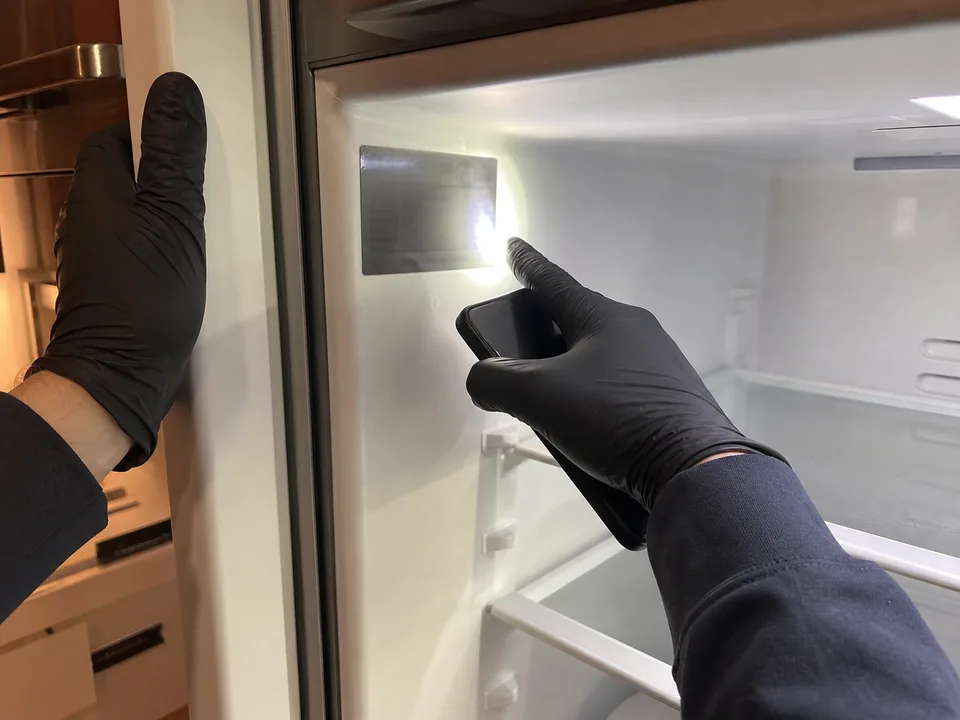
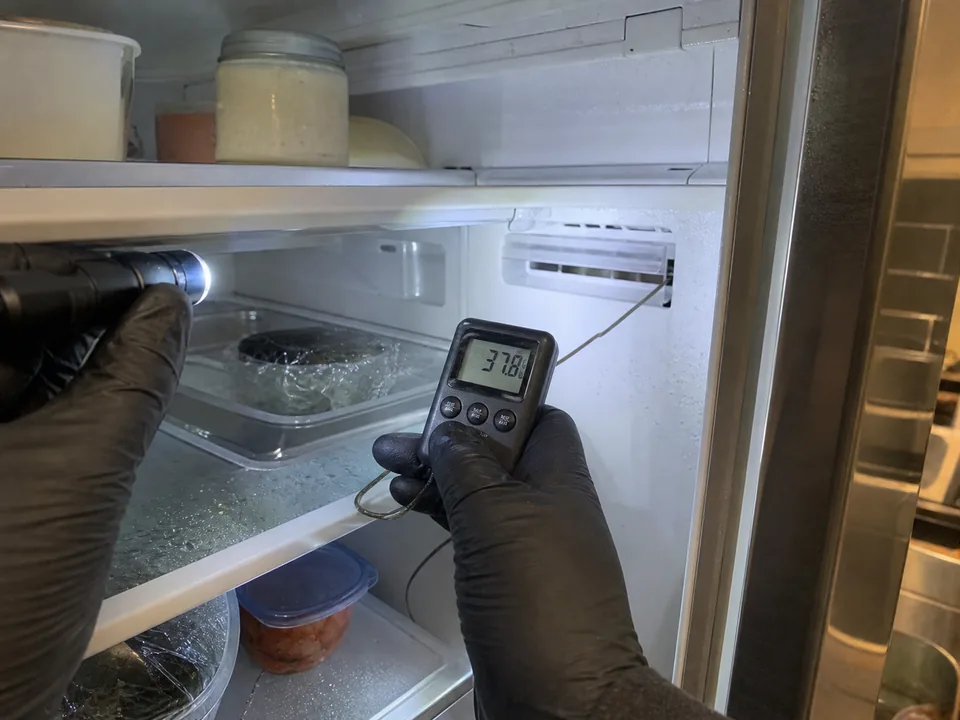
Model proof is collected from the cabinet before parts or repair scope are planned.Temperature proof is checked from the cabinet, not guessed from a display alone.
Workflow
What happens from booking to verification
Capture the local evidence: Record model/serial, 94901 or 94903 location, fresh-food/freezer temperatures, alarm timing and one wide cabinet photo before resets erase context.
Match the San Rafael access pattern: Use Dominican, Country Club, Peacock Gap, Sun Valley, Glenwood or Lucas Valley / Marinwood notes to plan parking, floor protection, panel weight and route timing.
Run the symptom-first test: For common-problem sorting, start with fill volume, filter age, valve response and freezer temperature. before naming a fan, gasket, valve, control board or sealed-system repair.
Set the quote boundary: Tie the written quote to the visible row Hollow ice or water symptom at $295-$885, then name the variables that can still change it: serial range, access, part availability and secondary failure.
Complete the repair only after proof: Install or adjust the confirmed component, then document temperature, ice, seal, alarm or wine-zone recovery instead of closing on a verbal claim.
San Rafael route logic
Local details are used only when they change the service plan
94901: older central homes, Mission San Rafael Arcangel area parking, and Downtown Fourth Street access can shape the appointment window.94903: northern San Rafael and Lucas Valley / Marinwood routes benefit from model-tag photos before stocking parts.Dominican and Glenwood: remodel age, hillside dust, and cabinet depth affect condenser airflow and pull-forward safety.Peacock Gap and Country Club: moisture, custom panels, and floor protection matter before gasket or sealed-system conclusions.
Repair economics
Published ranges still wait for model and failure proof
We publish San Rafael planning ranges because cost is one of the first things owners need to know for common-problem sorting: Hollow ice or water symptom $295-$885; Alarm/code problem $375-$1,285; Warm cabinet symptom sort $157-$237; Frost or condensation problem $420-$930.
Final quote variables are model family, serial range, part availability, access time, cabinet protection, water-line condition, whether the failed component is owner-visible, and whether qualified sealed-system verification is required.
Hollow ice or water symptom$295-$885 for fill volume, filter age, valve response and freezer temperature.Alarm/code problem$375-$1,285 for stored code, actual temperature, sensor/harness and control false positives.Decision pointCompare verified repair cost with new-unit disruption, cabinetry work and parts timing.
Customer reviews
What San Rafael Sub-Zero owners say
Real feedback from local homeowners after built-in refrigerator, freezer, wine, ice maker, and sealed-system service.
★★★★★
I described a warm cabinet and they correctly sorted it to an airflow problem rather than the compressor, just like the symptom guide suggested. A packed condenser and a slow fan were the culprits. The fresh-food side held 37 once they were addressed.
Walter M.Country Club, San Rafael
★★★★★
They matched my exact problem — a frost line at the door — and found the panel wasn't square, not just a worn gasket. They corrected the alignment and the seal together so it wouldn't keep recurring. Clearly knew what they were looking at.
Edith L.Glenwood, San Rafael
★★★★★
Quick, correct identification of why our ice maker had slowed down — a tired fill valve and an old filter, not the whole module. They tested the harvest cycle before committing to anything. Efficient and fair.
Howard S.San Anselmo
FAQ
Questions this page answers
What San Rafael detail changes common-problem sorting?
Neighborhood access can change the first step. Dominican and Sun Valley homes often have older built-ins and tighter floors, Country Club and Glenwood can add hillside dust and panel weight, and Peacock Gap moisture can expose weak seals. The diagnosis still starts with model proof, temperatures and safe access photos.
What price range should I use for common-problem sorting?
Use $295-$885 for hollow ice or water symptom as the planning line on this page. That range includes fill volume, filter age, valve response and freezer temperature. Final pricing changes only after the technician confirms model family, cabinet access, part availability and whether a secondary symptom is hiding the real failure.
Which number should be written down before common-problem sorting?
Write down the fresh-food temperature, freezer temperature, alarm time and model/serial tag before repeated resets. For ice or water symptoms, add filter age and cube shape; for wine storage, add set point and actual zone temperature. Those numbers make alarm/code problem easier to confirm.
How much does Sub-Zero repair cost in San Rafael?
San Rafael Sub-Zero repair should be treated as diagnostic-first: $150-$230 for the diagnostic/service call, $400-$900 for many gasket or frost-line repairs, $275-$850 for ice maker or water-line work, and $1,450-$3,600 for sealed-system work after proof. Final pricing depends on model, parts, access, and diagnosis.
Is same-day Sub-Zero repair available in San Rafael?
Same-day routing can be realistic for food-loss urgency when model, temperatures, access notes, and photos arrive early enough. Next-day is safer when the issue needs serial-matched parts, cabinet-safe pull-forward planning, or sealed-system verification. The page avoids promising a slot before route and parts constraints are known.
Ready for the next step?
Call or book online
Use the phone number or external booking page. Have the model tag, symptom timing, displayed temperatures, urgency, and cabinet-access notes ready.