 San Rafael Sub-Zero
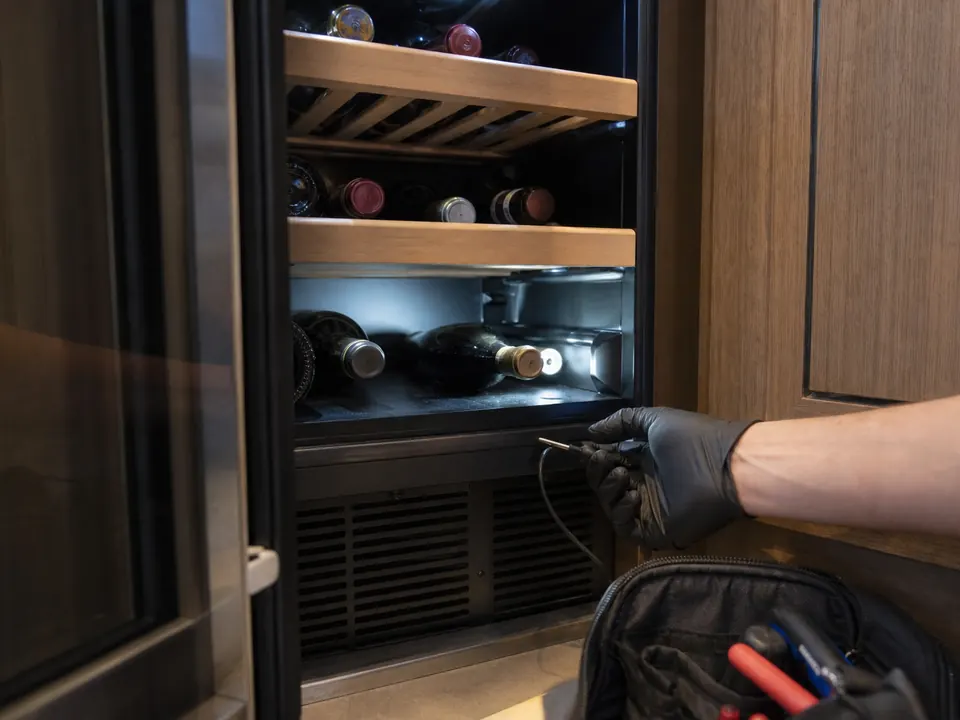
Freezer codes on a built-in Sub-Zero or similar panel-ready refrigerator are control-board alerts, and nearly all of them fall into 4 groups: door alarms, power-outage notices, temperature alarms and service faults. A healthy freezer holds about 0°F, so the first move with any code is to compare the display with a thermometer reading.
Sub-Zero rarely shows the owner a long numeric code; the control flashes the temperature, sounds a chime or lights a service indicator, and the detailed fault data is read in a service diagnostic mode. Built-in Viking, Thermador and GE Monogram refrigerators work the same way with different wording.
What do the four kinds of freezer alerts mean?
A door alarm on a Sub-Zero freezer means the door or drawer stayed open past a short timer. A power-outage notice means the board lost power and restarted, so the owner knows to check whether food warmed. A temperature alarm means the compartment stayed well above its set point longer than a door opening or defrost cycle would explain. A service indicator, or a flashing display the manual describes as a fault, means the board detected trouble with a monitored component: a temperature sensor, a fan motor, the defrost circuit or the link between the display and the main control board.
On a Sub-Zero freezer, the first two groups are information, the third is a symptom with several possible causes, and the fourth is a diagnosis already in progress, the group most likely to end in a part replacement.
Which freezer error codes can an owner safely clear?
Door alarms, power-outage notices, filter reminders and mode indicators are owner-side alerts on a Sub-Zero. For a door alarm, close the freezer door or drawer firmly and look for a frozen package or ice bin holding the gasket off the cabinet; a gasket that will not seat is a repair, not a reset. For a power-outage notice, acknowledge it, then check the temperature and the food.
Filter and ice-maker reminders on a Sub-Zero are timers, not faults, and clear once the filter is replaced and the indicator reset. In Gerstle Park, Marin's largest Victorian and Queen Anne district, soft Marin water rarely leaves heavy scale, so a filter light usually reflects filter age rather than a clogged line. Sabbath mode, which silences lights and some alarms by design, and a showroom mode that lights the display while the compressor stays off also look like failures; the use-and-care manual shows how to exit both.
How do you reset a built-in freezer without losing the clue?
A power reset can clear a one-time glitch on a Sub-Zero control board, but it also wipes the evidence, so order matters. Step 1: photograph the display and note when the alert started. Step 2: leave a thermometer in the freezer for 30 minutes and compare the reading with 0°F. Step 3: switch off the dedicated breaker for 5 minutes; on most built-ins the plug is hidden above the unit or in the cabinetry. Step 4: restore power and confirm the display and fans return. Step 5: keep the doors closed and allow up to 24 hours before judging the result.
If the same Sub-Zero freezer alert returns inside that 24-hour window, another reset will not fix it, and repeated cycling only blurs the pattern a technician needs to see.
Why does a temperature alarm keep returning?
A recurring temperature alarm on a Sub-Zero freezer usually starts with airflow or sealing. On most Sub-Zero built-ins the condenser sits at the top behind the grille, and dust there makes the compressor run long; cleaning it roughly every 6 months with a soft brush and vacuum, breaker off, is standard care.
Next, test the Sub-Zero freezer gasket: a strip of paper closed in the door should drag when pulled at several points. Then check the load, because packages pushed against the rear panel can block the evaporator fan vents, and a big batch of unfrozen food can trigger an alarm that clears within a few hours.
Frost on a Sub-Zero freezer finishes the story. Light frost near the door points to the gasket, while a thick, even layer across the rear panel suggests the defrost system is not completing its cycle, which is not an owner fix. If condenser, gasket and load all check out and the alarm returns, the cause is electrical or sealed-system.
When should a freezer code always go to a technician?
Some Sub-Zero freezer codes point to parts that need meters, diagnostic mode or refrigerant tools. A sensor or thermistor fault means the board can no longer read the temperature it controls. A fan fault, or a freezer that stays warm while the fan is silent, points to a motor or its wiring. A defrost fault, or heavy rear-panel frost, points to the heater, its termination switch or the control. A display-to-board communication fault needs electrical testing. Warm fresh-food and freezer sections while the compressor runs nonstop can mean a sealed-system problem. Any code that returns within 24 hours of a clean reset, a tripping breaker or a burning smell also belongs on that list.
Control board and sensor diagnosis on a Sub-Zero in San Rafael runs $375-$1285, and compressor or sealed-system work runs $1485-$3660; the $89 diagnostic fee is credited toward an approved repair.
Is food safe after a freezer temperature alarm?
Food safety after a Sub-Zero freezer alarm depends on how warm the food got, not on the code. Federal food-safety guidance says a full freezer holds a safe temperature for about 48 hours with the door closed, and a half-full one for about 24 hours. Food that still has ice crystals or reads 40°F or below can be refrozen, though texture may suffer. Log thermometer readings while waiting for service; how fast the Sub-Zero freezer warmed is useful evidence at the diagnostic visit.